

Notice It. Name It. Talk About It.
Turning Fall Moments into Early Literacy Moments
October is full of things for young children to notice. Leaves change from green to brilliant red, orange and yellow. The air becomes cooler. Acorns cover the ground, pumpkins appear on doorsteps, and fallen leaves make a wonderful crunch under little boots.
These everyday changes offer more than a chance to explore the season—they provide wonderful opportunities to build oral language, vocabulary and early literacy skills.

Long before children learn to read words on a page, they are developing the language skills that will help them understand what they eventually read. Oral language provides an important foundation for literacy development, and children’s vocabulary and understanding of spoken language are closely connected to later reading comprehension (Rvachew, 2025).
One of the simplest ways adults can support this development is through something they already do every day: talking with children.
Notice It
Children are naturally curious observers. Instead of always directing their attention, try slowing down and noticing what has captured their interest.
On a fall walk, a child might stop to examine a leaf, watch a squirrel or listen to geese flying overhead.
Follow their attention and wonder alongside them:
“You stopped to look at that leaf.”
“I hear something too. What do you think it is?”
“You found something underneath the tree!”
Following a child’s interests creates meaningful opportunities for conversation. Purposeful, back-and-forth conversations give children opportunities to use language, hear new vocabulary and receive feedback from responsive adults (Wasik & Hindman, 2024).
Name It
Once a child notices something, give them words for what they are experiencing.
A leaf isn’t only a leaf. It might be: crunchy • brittle • enormous • tiny • curled • damp • golden • smooth • jagged
The wind might: whistle • gust • blow • swirl • rustle
And that squirrel might: scurry • scamper • gather • nibble • leap
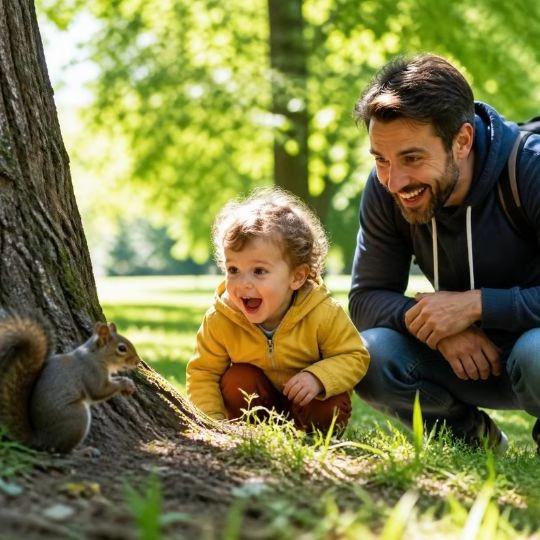
Children’s vocabularies grow through meaningful interactions and experiences. Adults can help by introducing interesting words naturally within conversations rather than turning vocabulary into a lesson (Johnston, 2010).
For younger children, simply name what they are looking at:
“Leaf! You found a red leaf.”
For children who are already using words and sentences, add a little more language to what they say.
Child: “Big leaf!”
Adult: “It is enormous! That’s an enormous maple leaf.”
You aren’t asking the child to repeat the new word or memorize it. You are simply giving them another word they can tuck away and hear again later.

Talk About It
The magic really happens when noticing and naming become conversation.
Instead of asking question after question, think about having a conversation together. Make a comment. Pause. Wonder aloud. Respond to what your child says and add another thought.
Try:
“I wonder why some leaves have changed colour and others haven’t.”
“That leaf feels different from the one you found before.”
“Where do you think that squirrel is taking the acorn?”
“What do you think will happen to this puddle when it gets colder?”
There doesn’t need to be a correct answer. The goal is to give children opportunities to think, describe, predict, wonder and tell you their ideas.
And Then… Connect It to a Book
Experiences also give children something powerful to bring to books: background knowledge. After exploring leaves outside, a book about autumn suddenly has personal meaning. A child can connect the crunchy leaf in the illustration to the crunchy leaf they held that morning.
The Public Health Agency of Canada encourages adults reading with preschoolers to connect what is happening in books with children’s real-life experiences, talk about illustrations and ideas, and use open-ended questions such as “What do you think will happen next?” (Public Health Agency of Canada, 2019). Those connections help children understand that the words and stories in books relate to the world around them.
Try It This October
The next time you head outside together, you don’t need a special literacy activity or a list of things to find.
Just remember three little steps:
NOTICE IT – Follow what catches your child’s attention.
NAME IT – Give them interesting words for what they see, hear, smell, touch and experience.
TALK ABOUT IT – Wonder, describe, predict and—most importantly—leave space for your child to talk.
A walk through the leaves may look like simple fall fun. But every crunchy, enormous, swirling and rustling conversation is helping a child build the language they will one day bring to reading and writing.
References
Johnston, J. (2010). Factors that influence language development. In R. E. Tremblay, M. Boivin, & R. DeV. Peters (Eds.), Encyclopedia on Early Childhood Development. Centre of Excellence for Early Childhood Development & Strategic Knowledge Cluster on Early Child Development.
Public Health Agency of Canada. (2019). Mind: Encouraging literacy in your child—Nobody’s Perfect. Government of Canada.
Rvachew, S. (Ed.). (2025). Language development and literacy. Encyclopedia on Early Childhood Development.